
History of Malaysia
Malaysia
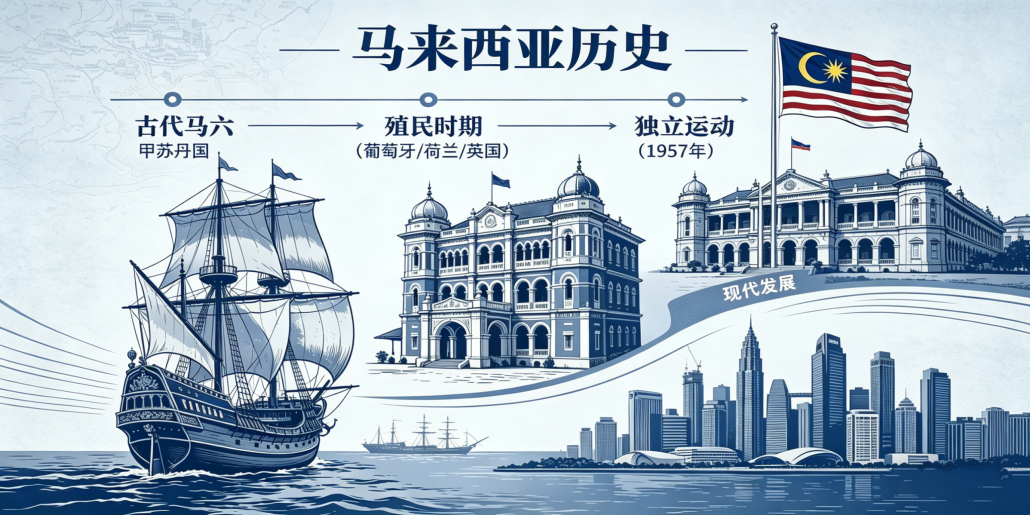
Malaysia is a multicultural and multiracial nation located in Southeast Asia, consisting of Peninsular Malaysia and East Malaysia (Sabah and Sarawak) on the island of Borneo. Its long and diverse history has shaped its unique social structure, rich cultural heritage, and stable modern economy.
The earliest civilisations in Malaysia date back thousands of years. In ancient times, the Malay Archipelago was dominated by powerful maritime kingdoms. The Srivijaya Empire, which flourished from the 7th to the 13th century, controlled major trade routes across the Straits of Malacca, making the region a vital hub for international trade between East Asia, South Asia and the Middle East. Later, the Malacca Sultanate rose to prominence in the 15th century, establishing formal Islamic governance and spreading Islamic culture throughout the peninsula.
From the 16th century onwards, Malacca and surrounding territories experienced colonial rule. The region was successively occupied by the Portuguese, the Dutch, and finally the British. Under British colonial administration, Malaysia developed systematic infrastructure, modern legal frameworks, and plantation economies focused on rubber, palm oil and tin mining, laying the foundation for its future economic development.
During World War II, Malaysia was occupied by Japan. After the war, the British resumed colonial rule. Growing local demand for independence led to continuous social reform and political development. In 1957, Peninsular Malaysia officially gained independence. In 1963, the Federation of Malaysia was formed through the merger of Malaya, Singapore, Sabah and Sarawak. Singapore later separated from the federation in 1965 and became an independent country.
In recent decades, Malaysia has developed rapidly into one of the most stable and prosperous countries in Southeast Asia. With a peaceful political environment, inclusive multicultural society, developed education system and mature real estate market, Malaysia has become a popular destination for international students, expatriates, property investors and global immigrants. Today, Malaysia continues to uphold cultural diversity, open trade policies and international cooperation, maintaining its important position in global business, education and cross-border investment.








Leave a Reply
Want to join the discussion?Feel free to contribute!